Buyer's guide · Printable formats · Adult groups
Choose a printable detective game that fits the room.
A printable “detective game for adults” can mean a two-person case file, a cut-and-hide escape room, a character party, or a full-group evidence investigation. The cover tells you the theme. The structure tells you whether the night will work.
Start with the format, not the artwork
The right choice depends on what every guest will do after the first clue appears. A strong product description should identify the supported headcount, the kind of participation, the host's access to spoilers, the physical preparation, and what counts as a complete solution.
| Format | What players do | Practical fit | Check before buying |
|---|---|---|---|
| Case-file mystery | Study one shared bundle of records and answer a final question | Solo play, couples, or a small table | Whether all pages arrive at once and how hints avoid spoilers |
| Printable escape room | Solve linked codes, locks, riddles, and reveal sequences | Puzzle-focused small groups | Cutting, folding, hiding, color, props, and reset requirements |
| Character mystery | Portray suspects, exchange secrets, and follow dialogue or round prompts | Social groups that actively want roleplay | Required roles, no-show resilience, scripts, and host duties |
| Evidence-team investigation | Investigate separate packets, report facts, and build one shared conclusion | Larger groups that prefer deduction over performance | Whether each team has meaningful evidence and the final proof uses every packet |
Use six questions before you buy
- Is the exact headcount supported? Look for both a minimum and maximum, then ask what changes between them.
- What does each person actually do? “Interactive” might mean acting, decoding, reading, searching the room, or comparing evidence.
- Can the organizer remain unspoiled? Setup instructions, hints, and the answer should be separated if the host wants to play.
- What preparation is hidden behind “print and play”? Count cutting, folding, envelopes, props, locks, color requirements, and advance messages.
- How does the game recover when players stall? Graduated hints preserve momentum better than one all-or-nothing answer page.
- Does the reveal prove the solution? A fair ending should connect the decisive clues and explain why plausible alternatives fail.
These questions matter more than page count alone. Forty decorative pages can produce less play than ten carefully linked records. Depth comes from the number and quality of deductions, the way evidence connects, and whether the final answer survives scrutiny.
“For adults” should describe the challenge—not hide the content
Adult mystery products range from clean logic games to stories built around murder, sexual relationships, alcohol, drugs, or graphic evidence. Age language is not a substitute for a content description. Check the incident, the themes, and what guests must pretend to do.
- Challenge: Are the deductions appropriate for the group's reading and reasoning comfort?
- Story stakes: Is the case a theft, disappearance, fraud, sabotage, or murder?
- Participation: Must anyone lie in character, flirt, accuse coworkers, or perform sensitive material?
- Accessibility: Do clues depend on color, tiny text, audio, a phone, or internet access?
- Event context: Is the license for a private gathering, an organization event, or public commercial use?
The Vanishing Vesperglass uses a clean artifact-heist premise. It has no murder, graphic violence, sexual content, alcohol requirement, assigned character deception, or personal-disclosure exercise. The difficulty is in evaluating evidence and combining four teams' findings.
What gives a detective game real depth?
Depth is not the same as duration, visual density, or the number of suspects. A satisfying investigation asks players to make several different kinds of inference and then connect them into one explanation.
| Quality | What it means | What to verify | Warning sign |
|---|---|---|---|
| Opportunity | Times, access, and movement constrain what was possible | The timeline and venue information agree | A suspect is eliminated by an unstated assumption |
| Mechanism | The method works under the documented physical conditions | Diagrams, records, and statements support the same process | The reveal introduces a device players never saw |
| Corroboration | Independent records reinforce or contradict a claim | More than one clue matters to the key conclusion | One ambiguous sentence decides the entire case |
| Motive | The reason fits the proven actions without replacing proof | Motive narrows an evidence-backed answer | The “most suspicious” personality is treated as guilt |
| Proof chain | The solution shows how the decisive facts connect | Rejected alternatives are addressed | The answer merely names a culprit |
The verified Vesperglass format
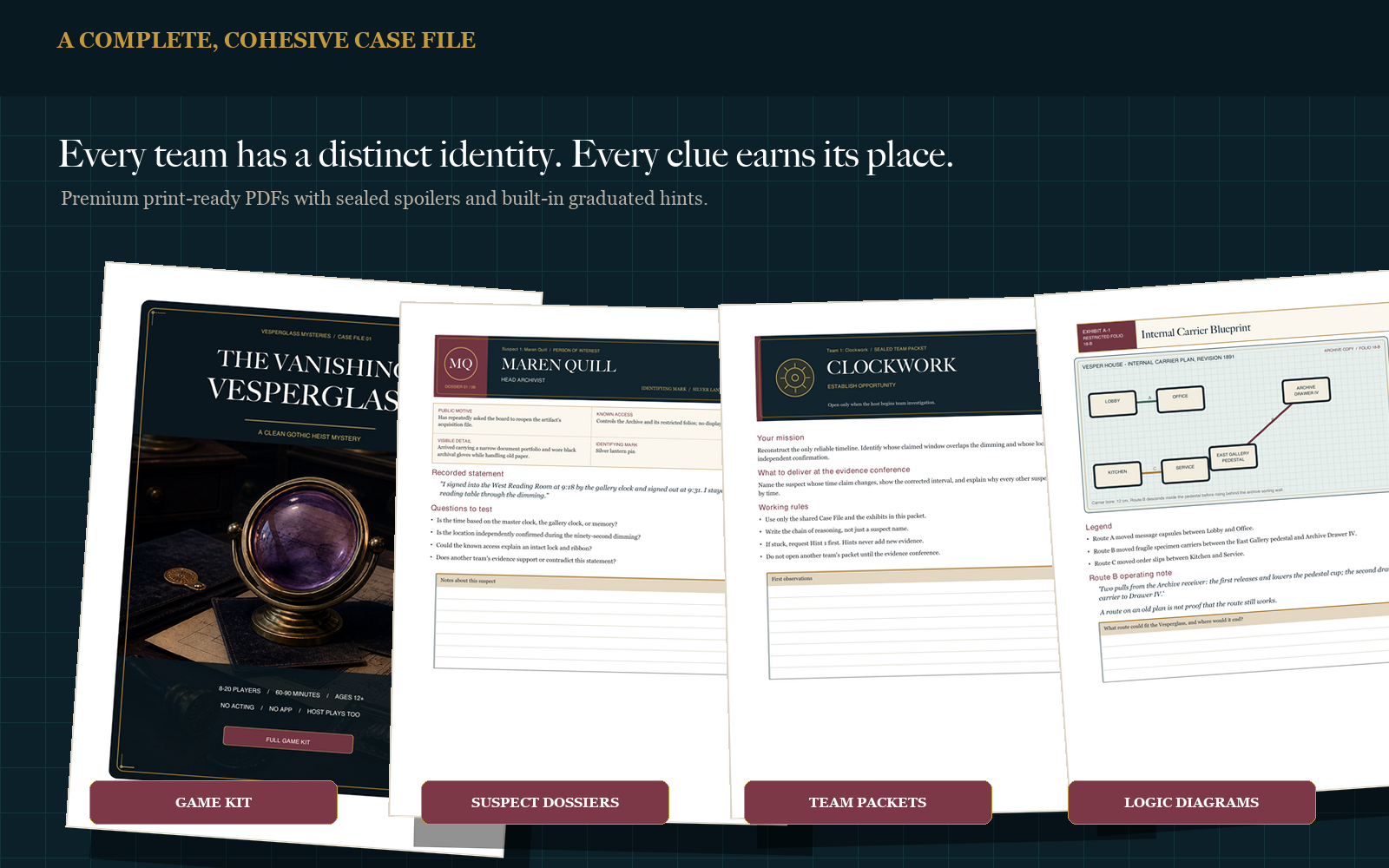
The Vanishing Vesperglass is an evidence-team detective game designed for 8–20 in-person players. Four teams receive different parts of a museum artifact-theft case, then meet for an evidence conference and answer who, how, where, and why.
- 37-page spoiler-free Game Kit with six public dossiers, venue evidence, four team packets, and accusation forms
- Separate six-page graduated Hint Deck and five-page Sealed Solution
- 60–90 minutes of play with roughly ten minutes of organizer setup
- Ordinary printer, paper, four pens, and four folders or clips
- Color-independent clues with black-and-white printing supported
- No app, account, QR code, cutting, hiding, costumes, scripts, or advance role assignment
At eight players, use four teams of two. At twenty, use four teams of five. The critical information belongs to team packets rather than optional character roles, so a cancellation does not remove a unique clue or force the organizer to rewrite the case.
A practical 75-minute run of show
A more conversational group can use the full 90-minute window. The separate hints let the organizer add only the amount of help the room needs.
When this game is not the right choice
Choose another format when your group wants theatrical suspect roles, an elaborate dinner script, a room-scale scavenger hunt, remote-only play, fewer than eight or more than twenty participants, or a game that can be replayed by the same people after they know the solution. For 1–4 players, use the free Silent Orrery mini-case instead.
If performance pressure is the main concern, read the no-acting format comparison. If the organizer wants to investigate, use the spoiler-free host checklist. For an office purchase, review the organization-event planning guide and select the correct license.
Frequently asked questions
What is a printable detective game?
It is a downloadable game in which players use printed clues, records, puzzles, or character information to solve a fictional case. Formats differ: some are compact case files, some are escape-room puzzles, some use character roleplay, and some divide a larger group into evidence teams.
How many people can play a printable detective game?
The supported count depends on the design. A case file built for one to four people does not automatically scale by printing more copies. The Vanishing Vesperglass is specifically structured for 8–20 in-person players in four evidence teams.
Do adults have to act or play characters?
Not in every format. Character mysteries ask guests to portray suspects, while evidence-led games let participants investigate as themselves. The Vanishing Vesperglass has no assigned personas, scripts, accents, costumes, or improvised alibis.
Can the organizer play too?
Only when the product separates spoiler-free setup from hints and the solution. The Vanishing Vesperglass provides a spoiler-free Game Kit and keeps its Hint Deck and Sealed Solution in separate files so the organizer can participate without learning the answer during setup.
Is The Vanishing Vesperglass a murder mystery?
No. It is a fictional museum artifact-theft investigation with no murder, graphic violence, sexual content, or alcohol requirement. It is intended for ages 12 and up, including adult groups that prefer clean story stakes.
What do I need to print and prepare?
For The Vanishing Vesperglass, use ordinary US Letter paper, four pens, and four folders or clips. Color and black-and-white printing are supported. Setup takes about ten minutes, with no cutting, hiding, app installation, QR codes, or advance character assignment.
Can I try the format before buying?
Yes. The Silent Orrery is a complete free 10–15 minute browser and printable mini-case for one to four players. It uses a different artifact, mechanism, motive, hiding place, and solution from the paid group mystery.