Buyer and hosting guide · 8–20 players
Planning a murder mystery party for a large group?
Start with the format, not the category label. A large group does not need twenty independent scripts: the lower-pressure alternative is a small number of evidence teams, clear handoffs, and one shared final decision.
Search language and story content are not the same
People often begin with “murder mystery party” when they want a social deduction event, but the phrase does not tell you whether a game uses a homicide premise, assigned suspects, scripted speeches, or document-based investigation. Check the actual incident and participation model before buying.
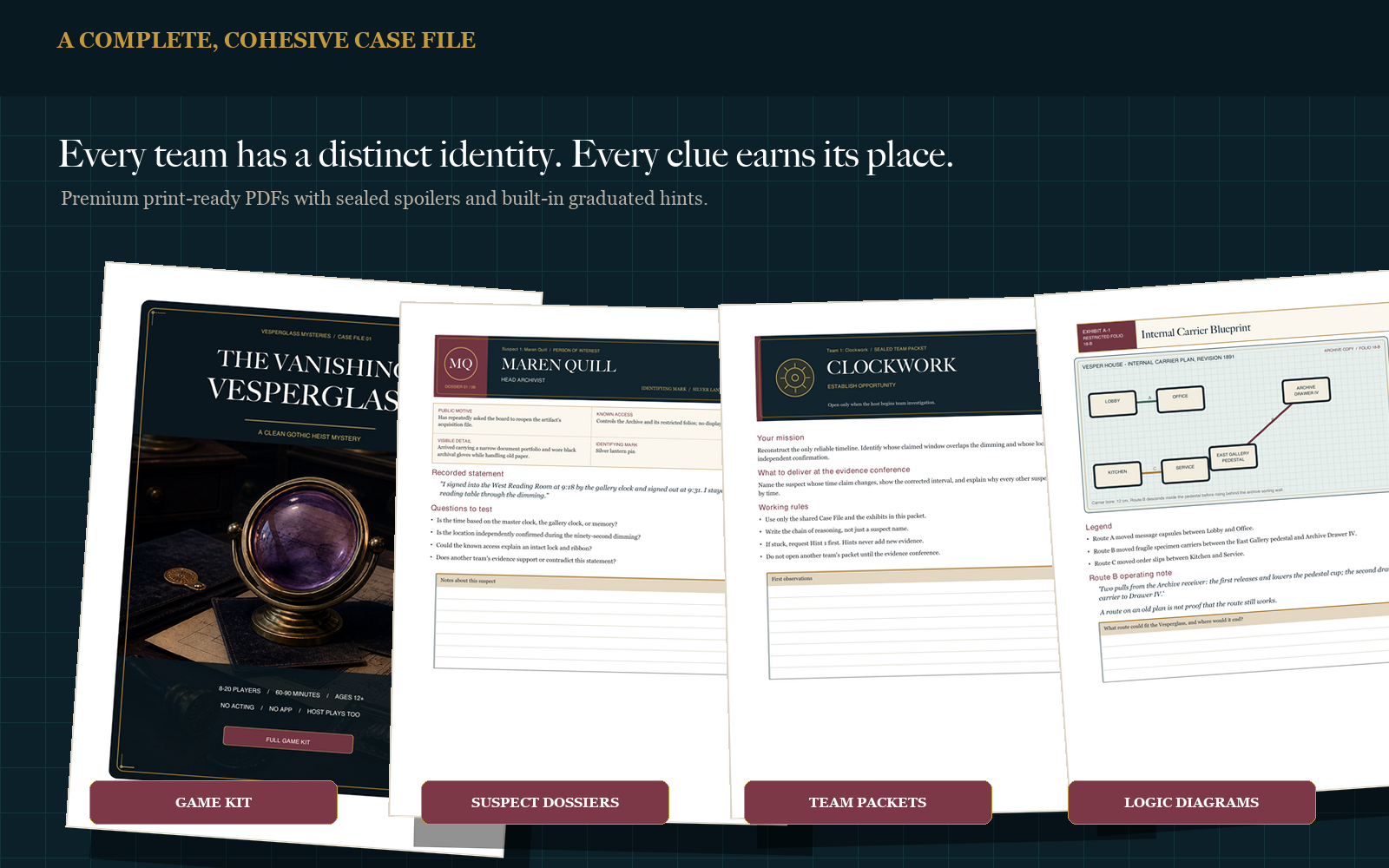
The Vanishing Vesperglass is not a murder mystery. Its central incident is a museum artifact theft with no death or graphic violence. Players work as investigators, not suspects, and nobody receives a character script. Choose a traditional character-led murder mystery when the crime premise, costumes, secrets, and performance are what your guests want.
Start with an honest headcount boundary
| Attendance | Practical format | Vesperglass fit |
|---|---|---|
| 1–4 | One shared mini-case | Use the free Silent Orrery case |
| 5–7 | A title designed for fewer teams | Not a direct fit |
| 8–20 | Four evidence teams of two to five | Direct fit |
| 21+ | A title licensed and designed for 21+ or a hosted event | Not a direct fit |
The limit applies to the complete paid game, not to how many people happen to be in the building. Do not split twenty-one or more participants into simultaneous Vesperglass rooms. The private, no-signup game finder recommends another format when the headcount or venue is outside the supported range.
Why large mystery games become unwieldy
Traditional role-based party mysteries often make every participant responsible for revealing one private fact. That can be delightful with eight confident actors, but it becomes fragile as the room grows. A late arrival, shy player, missed conversation, or unclear improvised statement can hide a clue the entire solution depends on.
The answer is not more host narration. It is to reduce the number of critical information paths. Put people into teams of two to five, give each team a complete evidence problem, and make the teams report what they can prove.
A four-team structure that scales
- Time and opportunity: establish when the event occurred and who could act.
- Mechanism and location: determine how the apparent impossibility worked and where the missing object went.
- Witness and corroboration: compare accounts against records rather than voting on personalities.
- Motive and provenance: identify who benefits and distinguish a plausible reason from the reason the evidence supports.
At eight players, use four teams of two. At twenty, use four teams of five. The number of reports stays constant, so the final discussion remains coherent.
Room setup and materials
Use four tables or corners, four folders or clips, four pens, and one printed packet per team. Keep graduated hints separate. Do not scatter evidence around the room unless searching is central to the design; hidden paper adds setup time and makes accessibility unpredictable.
A 75-minute run of show
Add up to fifteen minutes for a more social room. Avoid stretching the independent investigation after teams have stopped producing new deductions.
Protect the game from no-shows
Never attach a critical clue to an optional person. Critical evidence belongs in team materials that remain available regardless of attendance. A role may add personality, but the proof chain should survive the loss of any individual player. The host-can-play decision guide adds a six-point check for spoiler exposure, facilitator duties, apps, and cancellation risk.
Choose the right format
Use roleplay when your guests actively want performance, secrets, and improvised conversation. Use an evidence-team mystery when your group wants deduction, flexible attendance, or a lower-pressure activity. Neither is inherently better; the format should match the room.
Frequently asked questions
How do you run a murder mystery party for a large group?
Reduce critical information paths. Use a fixed number of teams, give each team a complete evidence problem, schedule one shared evidence conference, and require a written accusation before the reveal.
Is The Vanishing Vesperglass a murder mystery?
No. It is a fictional museum artifact-heist mystery with no murder or graphic violence. Players investigate evidence rather than performing suspects.
How many people can play The Vanishing Vesperglass?
The complete format supports 8–20 in-person players in four teams of two to five. It is not designed for fewer than eight, more than twenty, remote-only attendance, or simultaneous rooms.
Does every player need a character or script?
No. In an evidence-team format, clues belong to the printed packets rather than to optional characters. Choose roleplay instead when costumes, secrets, and improvised performance are the point of the event.
Can the organizer play too?
Yes. The 37-page Game Kit is spoiler-free, while the Hint Deck and five-page Sealed Solution stay separate until needed.