Organization event guide · 8–20 participants
A team-building mystery people can actually solve.
For a staff social, retreat, volunteer gathering, or small office event, the useful question is whether everyone can enter the task, contribute evidence, and reach a satisfying conclusion without forced performance or personal disclosure.
Why an evidence mystery works differently
Many group activities reward the loudest participant, ask colleagues to improvise characters, or depend on personal stories. An evidence-team mystery gives the room a shared external problem instead. People can contribute by spotting a detail, organizing a timeline, testing an explanation, taking notes, or presenting the team's conclusion.
The activity is still entertainment—not an assessment, diagnostic, or promise of improved performance. Its practical advantage is simply that collaboration emerges from a concrete case rather than from compulsory vulnerability.
The four-team operating model
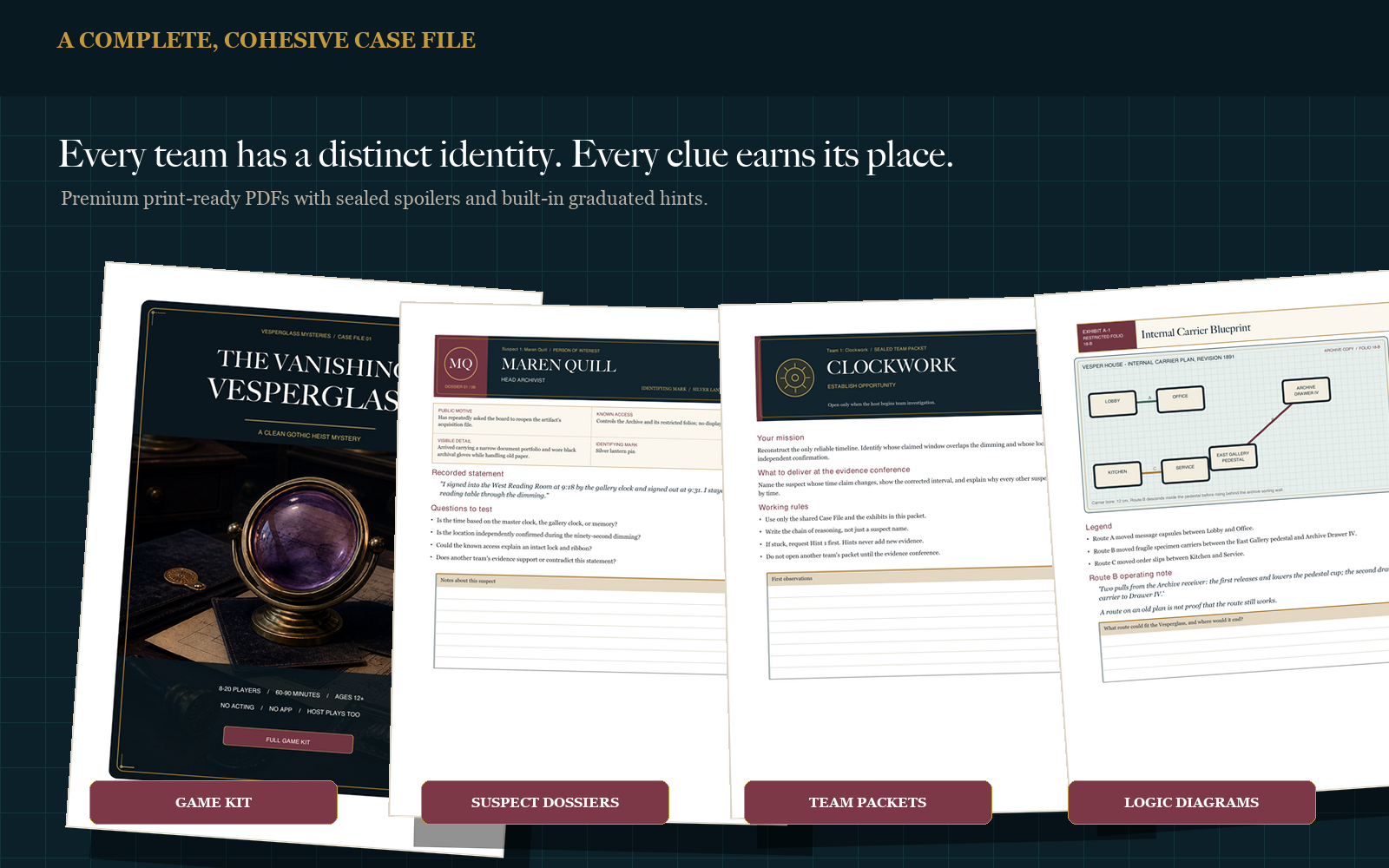
- Assign four teams of two to five. Each team receives a different but complete evidence packet.
- Investigate in parallel. Teams establish one part of the proof: opportunity, mechanism, witness corroboration, or motive.
- Hold an evidence conference. One spokesperson per team reports what the packet proves—not merely whom the team suspects.
- Lock one shared accusation. The room answers who, how, where, and why before opening the solution.
This structure keeps the number of final reports at four whether eight or twenty people attend. A no-show does not remove critical information because the evidence belongs to the packet, not to an optional character.
Exact team sizes for common office headcounts
Use all four evidence teams at every supported headcount. Assign the extra people to the first teams in the table; no participant carries a unique clue, so an uneven split does not change the solution or make a late substitution fragile.
| People | Clockwork | Archive | Witness | Motive |
|---|---|---|---|---|
| 8 | 2 | 2 | 2 | 2 |
| 10 | 3 | 3 | 2 | 2 |
| 12 | 3 | 3 | 3 | 3 |
| 15 | 4 | 4 | 4 | 3 |
| 16 | 4 | 4 | 4 | 4 |
| 18 | 5 | 5 | 4 | 4 |
| 20 | 5 | 5 | 5 | 5 |
For 9, 11, 13, 14, 17, or 19 people, keep team sizes within one person of each other. The free office mystery planner calculates the allocation, clock-time schedule, and print count for every supported headcount.
A 75-minute agenda
Choose a format your group will consent to
| Format | Best when | Watch for |
|---|---|---|
| Evidence teams | The group wants logic, discussion, and flexible attendance | Teams need a clear reporting handoff |
| Character roleplay | Guests actively want acting, secrets, and improvisation | Performance pressure and fragile clue delivery |
| Hosted event | Budget supports an external facilitator and custom production | Scheduling, travel, and substantially higher cost |
Offer participation as an activity, not as a surprise test. Provide a quiet observer or timekeeper option when appropriate, and state the clean fictional premise in advance so people can make an informed choice.
Corporate retreat fit: a two-minute decision
| Requirement | Direct fit | Choose another format when |
|---|---|---|
| Attendance | 8–20 people together at one event | 7 or fewer, 21 or more, or simultaneous rooms |
| Time | 60–90 uninterrupted minutes | The activity must finish in under 45 minutes |
| Venue | One physical room with tables or writing surfaces | Remote-only or hybrid participation is required |
| Participation | Evidence reading, discussion, and one shared accusation | Guests specifically want acting, costumes, or character secrets |
| Rights | One private internal organization event | The event is public, ticketed, resold, or redistributed |
If every direct-fit condition holds, the self-run Organization Event Edition removes facilitator scheduling and travel from the plan. It does not promise morale, training, engagement, or performance outcomes; it supplies a complete recreational case and a license for the stated event.
Organization Event Edition boundaries
The Organization Event Edition is $59 at automatic launch checkout (regular $69) for one concurrent 8–20 participant event run by one purchasing organization. It includes the same complete mystery and an organization-event license. It does not include facilitation, customization, resale, public ticketing, unlimited simultaneous teams, or claims about training outcomes.
- Clean artifact-heist story; no murder or graphic violence
- No acting, costumes, app, account, QR code, or internet dependency
- Organizer can investigate without reading the solution
- Color-independent deductions and black-and-white printing support
- Digital download; no physical item is shipped
Frequently asked questions
Does anyone have to act or perform?
No. Participants examine evidence in small teams, compare deductions, and present a conclusion.
Can the organizer participate?
Yes. The Game Kit is spoiler-free; the hints and Sealed Solution remain separate until needed.
Is the story workplace appropriate?
The fictional case is an artifact heist with no murder, graphic violence, sexual content, or alcohol requirement.
How many people can play?
The included format supports 8–20 participants in four evidence teams of two to five. Exact examples are shown for 8, 10, 12, 15, 16, 18, and 20 people.
Can this work during a corporate retreat?
Yes, when 8–20 people are together in one room for 60–90 minutes and the organizer can print the files. It is not designed for remote-only, public, ticketed, or 21-plus-player events.